

Choosing an airport construction company requires more than comparing completed buildings. When passengers, airlines, security personnel, and airport employees need to keep using a facility, the contractor must understand how construction changes the operating environment. Experience matters most at the points where a work zone, utility interruption, delivery, or temporary route could interfere with essential service.
At Magnum Builders, we help Southwest Florida owners evaluate airport upgrades as both construction projects and operational transitions. That means looking at the space being improved, the functions around it, and the conditions needed to keep unaffected areas working. The goal is not to promise that every activity can continue unchanged, but to develop a realistic approach that protects safety and limits avoidable disruption.
For airport authorities and municipal project managers comparing contractors, the most useful question is not simply whether a firm has worked at an airport. It is whether the proposed team can explain how it will coordinate access, phases, security requirements, scheduling, and reopening before those issues become field problems.
Can Airport Terminal Renovations Proceed Without Closing the Entire Facility?
Airport terminal renovations can proceed without a full shutdown when work is isolated in defined areas and affected services have approved alternatives. Owners and contractors should coordinate temporary check-in locations, passenger routes, access controls, and phase transitions before closures begin. Some spaces or services may still require temporary restrictions.
San Francisco International Airport's Terminal 3 construction notice describes west-end ticket counter closures alongside open east-end counters, alternative check-in locations, and interim post-security walkways around construction. The example illustrates continuity through coordinated alternatives, not an absence of operational changes.
An aviation construction company should be evaluated on the responsibilities of the proposed project, not just the facility's name. A terminal finishes renovation, a baggage-system expansion, a checkpoint alteration, and a parking improvement involve different interfaces. Owners should ask what the contractor managed directly, which specialists participated, and how the team coordinated work with ongoing operations.
For active airport projects, we recommend discussing the assigned project manager and superintendent early. Ask how they would investigate existing conditions, establish work boundaries, schedule deliveries, coordinate shutdowns, and manage turnover. A useful response should identify the information and approvals needed before committing to a sequence.
Proposal comparisons should also make operating assumptions visible. If one contractor assumes unrestricted daytime access while another includes limited work windows and temporary protections, the prices may not represent the same construction approach. The owner needs a shared basis for comparing scope, staffing, schedule, and operational impact.
We encourage this discussion before selection rather than after mobilization. A clear explanation of constraints is more valuable than an immediate promise that construction will be invisible to passengers. Experience should produce better planning questions, not fewer questions.
Phased construction should explain what the airport can keep using while each area is upgraded. Dividing a project into zones is only the starting point. The plan must also address the services, routes, and supporting systems that make those zones usable.
For example, keeping a baggage claim area open has limited value if passengers cannot reach it from the arrival route. A temporary checkpoint approach needs more than an opening in a barrier; the owner should review how queues, circulation, signs, and adjacent functions will work together. Each phase should be tested against the full passenger journey.
We recommend defining the conditions for moving from one phase to the next. Those conditions may include inspections, cleaning, equipment checks, operational review, and confirmation that the replacement route is ready. Starting the next work area too soon can remove capacity before the previous phase has genuinely returned it.
The shortest construction sequence is not always the most practical operating strategy. A longer phased approach may preserve important services, while a carefully planned short closure may be safer and more efficient for a particular task. Owners should compare those options openly instead of assuming that remaining operational means keeping every space available.
An airport upgrade schedule should reflect when work can actually be performed and when the facility needs the affected area back. An overnight shift is not automatically a full shift of productive installation. Access, protection, setup, testing, cleanup, and preparation for reopening all need time.
We recommend identifying critical interruptions before the field schedule is finalized. A utility connection, equipment changeover, or temporary route transition may need agreement from facilities personnel, security teams, airlines, specialist vendors, and the owner. The schedule should show those decisions and preparations, not only the installation date.
Materials also need to be ready for the operating window. A crew available on the right night cannot complete a changeover if an approved component, specialist, or inspection resource is missing. Procurement tracking should connect each item to the phase that depends on it.
Recovery planning is especially important when the airport needs an area restored by a fixed time. Before work starts, the team should agree on decision points, escalation contacts, and the approved response if a connection or test cannot be completed. A realistic fallback is stronger protection than an optimistic duration.
For a broader discussion of these relationships, our aviation construction planning guide examines how scope, phasing, scheduling, and operational readiness fit together. That wider planning view helps owners assess the logic behind a contractor's proposed sequence.
Airport construction safety measures must be established for the actual work location and scope. Public terminal work, controlled-access areas, and work affecting aircraft operations should not be treated as interchangeable. The project team should confirm the applicable requirements with the airport and responsible authorities before crews arrive.
We recommend reviewing personnel access, required credentials or escorts, delivery arrangements, work boundaries, emergency access, and the handling of materials and debris. A normal construction permit does not answer every question about access to an airport work area. Security coordination and construction authorization need clear ownership.
Temporary protections should also be reviewed as conditions change. Barriers, signs, lighting, accessible routes, and housekeeping arrangements may need adjustment between phases. A safe setup at the beginning of a project should not be assumed to remain suitable after adjacent routes or activities change.
The contractor should know when an issue requires the airport's decision rather than a field workaround. If the agreed separation or protection cannot be maintained, the affected activity should pause while the responsible parties resolve the conflict. Operational continuity is never a reason to accept unsafe conditions.
Airport terminal renovations should be evaluated by the systems and services they affect, not just the finishes being replaced. Ceiling work may require coordination with lighting, ventilation, communications, and fire protection. Counter changes may involve power, data, equipment, accessibility, and the flow of passengers waiting for service.
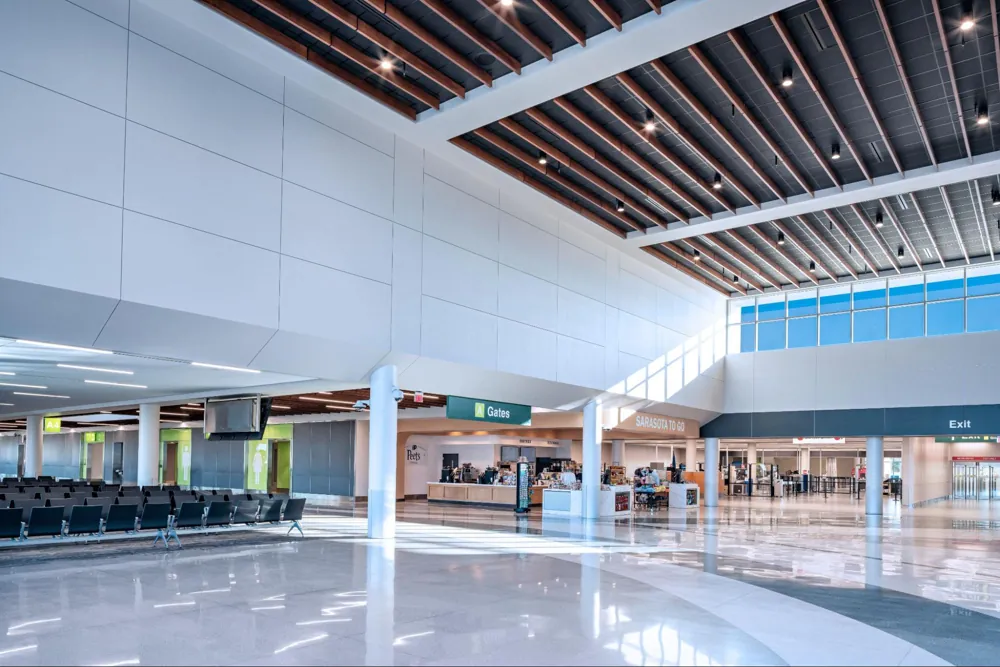
At Sarasota Bradenton International Airport, our baggage claim renovation included new finishes, mechanical work, electrical and lighting work, low-voltage systems, rental car counter renovations, and terrazzo flooring. This is a useful example of a public-facing renovation with several construction disciplines to coordinate. The visible improvement is only part of the scope an owner should evaluate.
For baggage claim expansions, we recommend distinguishing the public-space work from any baggage equipment, controls, or airline interfaces. The project should identify who designs, supplies, installs, tests, and accepts each component. Responsibility gaps can delay an opening even when individual contractors believe their own work is complete.
TSA renovations require the same clarity about interfaces and approvals. Construction sequencing should be coordinated with the affected screening operation and relevant stakeholders, rather than assuming that a physically finished space is ready for use. The planned transition needs to be understandable to the people responsible for both the project and daily operations.
Parking infrastructure and curbside improvements are part of the airport's operating system, not separate conveniences outside the terminal. A passenger may encounter construction first at a roadway, parking entrance, shuttle stop, or crossing. The plan should address that approach before focusing only on the terminal interior.
Our Sarasota Bradenton International Airport curbside improvements combined roadway, canopy, utility, lighting, crosswalk, signage, and related work using phased construction and night and day shifts. When reviewing similar projects, we recommend asking how the contractor will maintain an understandable connection between arrival routes and the building. A temporary traffic arrangement should be evaluated from the user's perspective as well as the work crew's.
For parking upgrades, the team should also check for conflicts with other airport projects. Closing a parking area and changing a terminal entrance at the same time may create an impact neither schedule identifies independently. Transportation facility construction needs coordination across project boundaries, including work managed by different contractors.
The practical test is whether passengers, employees, deliveries, and ground transportation services can understand and use the temporary arrangement. Completing one part of the route does not establish that the whole journey works.
Project delivery should give the owner clear information and decisions, not simply more reporting. The team needs a defined process for design questions, access changes, schedule constraints, costs, and upcoming operational transitions. Updates should identify what requires action and who has authority to resolve it.
Our Construction Management services support planning, budgeting, scheduling, design coordination, procurement, and construction through completion. For active airport upgrades, that coordination should keep operational assumptions visible as design and field conditions develop. An unresolved access or shutdown issue belongs in the project discussion before it threatens the next phase.
For public agencies planning eligible recurring work, our Continuing Contract Services provide another delivery route under agreements that meet the client agency's purchasing requirements. The agency should verify project eligibility, procurement requirements, and current contract terms before selecting that route. An existing agreement is not a substitute for defining the scope and operating conditions of each assignment.
Whether the work is a single renovation or a series of aviation infrastructure projects, the delivery structure should support practical accountability. Owners should know who coordinates the trades, who communicates with airport departments, and who confirms readiness for each transition. A contract label alone does not establish that those responsibilities are covered.
The right airport construction partner should explain how the work will be delivered while the surrounding facility continues serving people. That means making assumptions visible, coordinating realistic work windows, protecting access, and establishing clear conditions for each phase transition. Owners comparing contractors should expect a practical account of these responsibilities rather than a broad promise of minimal disruption.
At Magnum Builders, we bring our Southwest Florida aviation experience to conversations about the next improvement without assuming that every airport project is the same. We want to understand your operating priorities, existing conditions, stakeholder requirements, and target milestones before recommending a construction approach. That discussion helps turn contractor experience into a plan specific to your facility.
If you are evaluating a terminal upgrade, baggage claim project, TSA renovation, parking improvement, or related transportation facility work, speak with us while the sequencing options are still open. We can review the operational constraints with your team and discuss how planning, coordination, and project delivery can support the upgrade.
Contact Magnum Builders for Your Aviation Project

